Sunday, July 10, 2016

Wednesday, April 1, 2015
plaster casting and mask creation
Last week, with the support of Robin Adair and Carol Wylie from the Mendel Art Gallery, the students created masks from plaster casting. The process was a lot of fun and the students are excited about their creations. Most of the students in my class made animal masks to be used in the play as spirit animals from the Boreal Forest. One student made his mask to look like David Suzuki, who has a cameo appearance in our play. The grade eight students created caricatures to be used in a song they are performing about consumerism.
Before Robin and Carol arrived, I had my students print a picture of the animal mask they wanted to created. They simply Googled animal masks and were able to view many different styles. When Robin arrived, he had a giant tote with everything we needed to start the creation. He gave students each a plastic garbage bag to wear so that their clothing was protected. Students chose a partner to work with, were given some plaster bandaging and a container of water, and instructed to slather Vaseline on their faces. I brought hair ties and elastic headbands to help the kids keep their hair out of their masks.
Robin was fantastic, and his instructions were clear and easy to follow. The students were excited, and therefore a bit noisier than usual. Robin told the students to cast their partner's face, removed the cast, and then repeated the process again with the other partner being cast. Once the process got underway, the students quieted down and became absorbed in their task.
After they pulled the casts off of their faces, they began the work of building animal faces right onto the plaster casts. We did this to save time instead of building a mask off of the cast that would eventually be removed.
Robin helped students figure out how to create antlers, a proboscis, ears, and a beak. This part of the process took us an entire afternoon. I'm sure we could have kept creating, but before we knew it, it was the end of the day.


The next morning, while we still had all the mess out, we decided to continue working with the plaster casting to finish up our masks. Later in the afternoon, we got out acrylic pain and began painting the masks. We still have detail work that we need to finish, but we are close to being done this portion of the project.
The support and help from the Mendel Art Gallery was invaluable. When running an ArtsSmarts grant there is always so much to to do and coordinate, and without this support, I'm not sure what we would have done for masks - perhaps paper plates with eye holes cut out? They had access to the supplies necessary and the expertise to help us learn this process. As a teacher, I try to soak up these learning moments as much as possible. This is something that I think I could now do on my own, if I could find, and afford, the materials.
As for student learning, I saw lots of it. Students were problem solving in real time. They had to figure out how to create their own animal by learning a technique. They had questions like, "How to I build a muzzle?" and then they had to solve that problem on their own. Sometimes we think of a project like this as frivolous and fun, but in thinking that way, we fail to give credit to the real learning that is taking place. Our children need to have opportunities to have problems to solve on their own. They need to be able to try something, have it fail, and attempt to do things in a different way. The arts are a great place to allow for this learning to take place.
In working with a partner, students had to communicate their ideas, put faith in their partner, and work hard to help their partner to create a strong sturdy mask that could support additional features. As well, because their were only 4 adults in the room, students had to teach each other. Several students created a wolf mask, but I only had to help the first student with the creation of their muzzle. After that, they were the "expert" and could teach another student.
I'm not sure what the education program at the new Remai Arts Center will be, but I have certainly enjoyed working with the staff at The Mendel. I hope that the programing for schools is still accessible in the way that it has been through the Mendel. On behalf of St. Anne School, thank you to Laura Kinzel and the Mendel Art Gallery staff for you support, assistance, and partnership over the past three years. Thank you for your hard work with our students while you supported our ArtsSmarts projects. We have been so fortunate.
For anyone reading this blog, please check out our mural at the Mendel Art Gallery in the auditorium. It will be there until April 19th.
Thank you to our sponsors!

Before Robin and Carol arrived, I had my students print a picture of the animal mask they wanted to created. They simply Googled animal masks and were able to view many different styles. When Robin arrived, he had a giant tote with everything we needed to start the creation. He gave students each a plastic garbage bag to wear so that their clothing was protected. Students chose a partner to work with, were given some plaster bandaging and a container of water, and instructed to slather Vaseline on their faces. I brought hair ties and elastic headbands to help the kids keep their hair out of their masks.
Robin was fantastic, and his instructions were clear and easy to follow. The students were excited, and therefore a bit noisier than usual. Robin told the students to cast their partner's face, removed the cast, and then repeated the process again with the other partner being cast. Once the process got underway, the students quieted down and became absorbed in their task.
After they pulled the casts off of their faces, they began the work of building animal faces right onto the plaster casts. We did this to save time instead of building a mask off of the cast that would eventually be removed.
Robin helped students figure out how to create antlers, a proboscis, ears, and a beak. This part of the process took us an entire afternoon. I'm sure we could have kept creating, but before we knew it, it was the end of the day.
The next morning, while we still had all the mess out, we decided to continue working with the plaster casting to finish up our masks. Later in the afternoon, we got out acrylic pain and began painting the masks. We still have detail work that we need to finish, but we are close to being done this portion of the project.
The support and help from the Mendel Art Gallery was invaluable. When running an ArtsSmarts grant there is always so much to to do and coordinate, and without this support, I'm not sure what we would have done for masks - perhaps paper plates with eye holes cut out? They had access to the supplies necessary and the expertise to help us learn this process. As a teacher, I try to soak up these learning moments as much as possible. This is something that I think I could now do on my own, if I could find, and afford, the materials.
As for student learning, I saw lots of it. Students were problem solving in real time. They had to figure out how to create their own animal by learning a technique. They had questions like, "How to I build a muzzle?" and then they had to solve that problem on their own. Sometimes we think of a project like this as frivolous and fun, but in thinking that way, we fail to give credit to the real learning that is taking place. Our children need to have opportunities to have problems to solve on their own. They need to be able to try something, have it fail, and attempt to do things in a different way. The arts are a great place to allow for this learning to take place.
In working with a partner, students had to communicate their ideas, put faith in their partner, and work hard to help their partner to create a strong sturdy mask that could support additional features. As well, because their were only 4 adults in the room, students had to teach each other. Several students created a wolf mask, but I only had to help the first student with the creation of their muzzle. After that, they were the "expert" and could teach another student.
I'm not sure what the education program at the new Remai Arts Center will be, but I have certainly enjoyed working with the staff at The Mendel. I hope that the programing for schools is still accessible in the way that it has been through the Mendel. On behalf of St. Anne School, thank you to Laura Kinzel and the Mendel Art Gallery staff for you support, assistance, and partnership over the past three years. Thank you for your hard work with our students while you supported our ArtsSmarts projects. We have been so fortunate.
For anyone reading this blog, please check out our mural at the Mendel Art Gallery in the auditorium. It will be there until April 19th.
Thank you to our sponsors!
Tuesday, March 31, 2015
music is an art that comes from the heart
It turns out that writing a song is actually pretty difficult. I have never written a song before, but I imagined that it would be similar to writing poetry. Before we embarked on our ArtsSmarts project, I thought that our students would enjoy "playing" and "experimenting" with song. I imagined that as a class, and in small groups that we could use Garage Band on the iPads and "play" our way towards writing a song. Maybe I was right, but it started to feel like we could spend all the time in the world playing and never get a song written.
For some background information, I have to tell you that we don't have a music program at our school. We have band for students who are interested, and we have a choir. We are a small school, with a small staff, and we haven't had a music teacher that has taken on choir and music. I tell you this just so that you are aware of where we were starting from. Our students, largely, do not feel like they are musical. The few students who have had music training were in hiding, and it was fairly difficult to get them to take a risk and stand out in front of their peers. This certainly doesn't seem to be the case anymore as we've had a piano in our room for over a month and it now seems like everyone is a composer!
We knew that we wanted to write songs about the environment and consumption. My grade seven class would take on the role of ecologists/tree-huggers in our play, and the grade eights, who were ecology experts last year, would take on the role of developers and consumers. What I had hoped for was that I could front-end load the ecology information as quick as possible so that my students would have the necessary background to be able to write songs pertaining to the environment. Six of my current students were in my 6/7 class last year, and this information was not new to them. I believed that they would be able to lead the way. To say this was a challenge would be an understatement.
Here's the thing, song writing is risky business. You have to be willing to put your ideas out there. That's not easy. I have also come to see that creating comes from your heart, and learning about different ecosystems from a text book and a few videos does not really foster the kind of love for nature that is needed to write a song about it. I could spend the entire blog telling you all about the mistakes I made, but instead, I will briefly touch on my mistakes as I tell you what I would do differently if I were able to go back in time or if I ever take on a project like this again.
1.) Get outside!
I would spend more time outside learning. We took on this project in January, in Saskatchewan, which might not be the best time to be learning about ecosystems. I should have done some outdoor educaiton in the fall. We could have gone to Eagle Creek, and taken nature walks down by the river. We also could have spent time writing poetry in nature. I could have given the students a format to follow and let them go sit under a tree to write a few poems. The poems could have been sensory in nature, describing the beauty of what they saw, felt, smelt, and heard.
2.) Using photos to create wonder and awe
I should have thought bigger. I should have given the children something to be inspired by: a photo, and small news piece, short videos, things that would have caused awe and wonder. I could have added this little piece to our daily morning Language Arts routine. Our planet is awesome and we should have been celebrating it every day. To be fair, I did show the students many fascinating and interesting articles and videos, but I only started the eco info when we began this project. The kind of deep learning that was required for the song writing needed to be taking place all year long in small doses.
3.) Build confidence through scaffolding
I could have given the students time to create a small music piece. (Not just once, but several times.) I should have put them in groups of 3-4 students and given them a the task of creating a small song. I could have started really small and built on their growing skills as time progressed. At first the tasks could have been simple, like create a poem about an animal following this three line format.:
The (noun),
(where it is)
(verb).
Ex:
The bird,
in the tree
sings!
After the poems were created, their next job would be to make a simple beat to speak the poem to. Students could have been given twenty minutes to create the poem and beat, and then been told they would share their creation. After each performance the creators could bow while the class cheers and claps. This would have been a way to scaffold the process so that by the time we worked with our artists, the students already saw themselves as creators of music. This would have also helped their confidence.
I am an introvert. I was the last kid that would have been creating music or volunteering for an acting or dancing part. In fact, this project would have likely scared the heck out of me. I would have wanted to create the props and background. All along I have been aware that what I'm asking kids to do is take a risk and that for some of them this makes them uncomfortable. I also know that this is where growth comes from: those moments when you take a risk not knowing if you will succeed or fail. If you succeed, the growth is in confidence. If you fail, the growth is in trying again in a different way. While I am telling you the things I would change, I realize that this could be taken as failure. I haven't failed, I have just learned that a different approach may have worked better.
We have talented artists, and thankfully, even though I may have failed to prepare my students adequately, we do have amazing songs and raps. The artists met several times with our students and would start by sharing what they had already created. Often they had already worked out the melody on the piano and the chorus and then asked the students to help them create the verses. This was often done in small groups instead of the whole class. A few of the songs were songs that the artists had already started, but this project gave them the inspiration or push to complete the songs.
Over the past several weeks we have been practicing and learning the songs. One song called In the Beginning was created by my class from start to finish under the direction of Elizabeth Bekolay. They created the melody on the spirit flutes and worked on spoken word poems to describe different animals of the forest. These lines are often beautifully told from the point of view of the animal they describe. After the song was finished, we asked for volunteers to create dances to go with each animal section of the song. Students were tasked with creating a dance that worked with the melody and beat of the song, but also symbolically represented that animal. The flute players were needed to play the songs for the dancers as the dancers collaborated and created their dances. During these sessions I saw some of the best student collaboration. I watched a student in my class, who often has trouble with collaboration, openly and willingly collaborating. She was open to other suggestions and actively giving positive support as well as sharing her own ideas. I wonder and hope that this positive collaboration will transfer over into other subjects. Collaboration is a learned skill, and I witnessed that learning taking place.
So we have 9 days to go before we perform our play for the entire school and wider community. I would love to say we are all done with the creation, but we are far from it. My class still has two dance pieces to create. We plan to push really hard over the next two days to create and memorize those dances so that when we get back after the spring break we can start running through the play every day. I know that it will come together and be quite amazing, but it's really hard to not be anxious at this late stage in the game.
I will share a few of our songs with you through the links below. We haven't created a recording of the students singing yet, but these are the early versions of the songs sung by our artists, Elizabeth Bekolay and Jordan Schultz. The last few are the flute pieces created by our students with Elizabeth.
Rap Battle
Impact Song
Spirit Flute: Butterfly
Spirit Flute: Owl
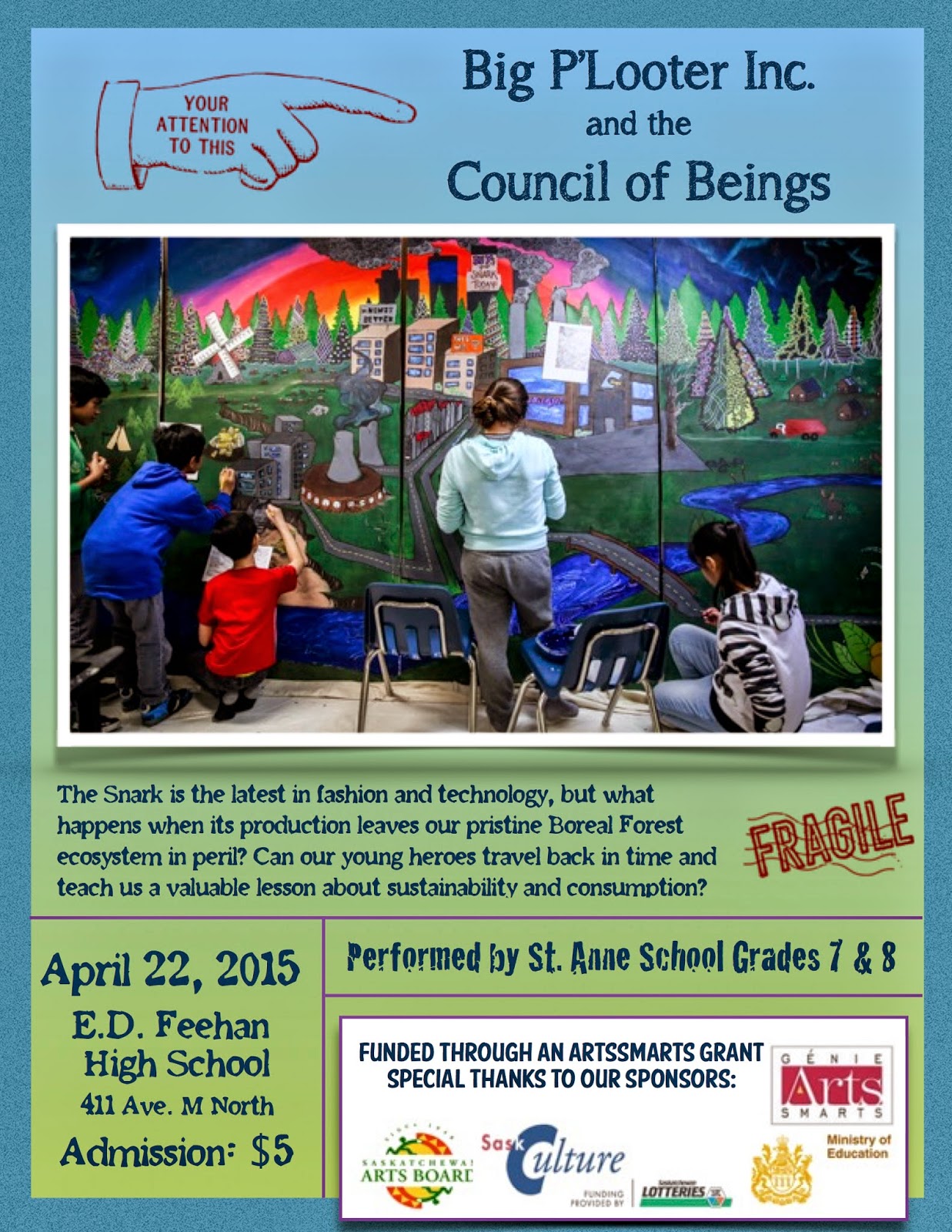
Here is the official invite for anyone who is interested in attending. We may open up a second showtime once we have had a chance to get some feedback from parents.
 Thank you to The Saskatchewan Arts Board and their fundholders:

For some background information, I have to tell you that we don't have a music program at our school. We have band for students who are interested, and we have a choir. We are a small school, with a small staff, and we haven't had a music teacher that has taken on choir and music. I tell you this just so that you are aware of where we were starting from. Our students, largely, do not feel like they are musical. The few students who have had music training were in hiding, and it was fairly difficult to get them to take a risk and stand out in front of their peers. This certainly doesn't seem to be the case anymore as we've had a piano in our room for over a month and it now seems like everyone is a composer!
We knew that we wanted to write songs about the environment and consumption. My grade seven class would take on the role of ecologists/tree-huggers in our play, and the grade eights, who were ecology experts last year, would take on the role of developers and consumers. What I had hoped for was that I could front-end load the ecology information as quick as possible so that my students would have the necessary background to be able to write songs pertaining to the environment. Six of my current students were in my 6/7 class last year, and this information was not new to them. I believed that they would be able to lead the way. To say this was a challenge would be an understatement.
Here's the thing, song writing is risky business. You have to be willing to put your ideas out there. That's not easy. I have also come to see that creating comes from your heart, and learning about different ecosystems from a text book and a few videos does not really foster the kind of love for nature that is needed to write a song about it. I could spend the entire blog telling you all about the mistakes I made, but instead, I will briefly touch on my mistakes as I tell you what I would do differently if I were able to go back in time or if I ever take on a project like this again.
1.) Get outside!
I would spend more time outside learning. We took on this project in January, in Saskatchewan, which might not be the best time to be learning about ecosystems. I should have done some outdoor educaiton in the fall. We could have gone to Eagle Creek, and taken nature walks down by the river. We also could have spent time writing poetry in nature. I could have given the students a format to follow and let them go sit under a tree to write a few poems. The poems could have been sensory in nature, describing the beauty of what they saw, felt, smelt, and heard.
2.) Using photos to create wonder and awe
I should have thought bigger. I should have given the children something to be inspired by: a photo, and small news piece, short videos, things that would have caused awe and wonder. I could have added this little piece to our daily morning Language Arts routine. Our planet is awesome and we should have been celebrating it every day. To be fair, I did show the students many fascinating and interesting articles and videos, but I only started the eco info when we began this project. The kind of deep learning that was required for the song writing needed to be taking place all year long in small doses.
3.) Build confidence through scaffolding
I could have given the students time to create a small music piece. (Not just once, but several times.) I should have put them in groups of 3-4 students and given them a the task of creating a small song. I could have started really small and built on their growing skills as time progressed. At first the tasks could have been simple, like create a poem about an animal following this three line format.:
The (noun),
(where it is)
(verb).
Ex:
The bird,
in the tree
sings!
After the poems were created, their next job would be to make a simple beat to speak the poem to. Students could have been given twenty minutes to create the poem and beat, and then been told they would share their creation. After each performance the creators could bow while the class cheers and claps. This would have been a way to scaffold the process so that by the time we worked with our artists, the students already saw themselves as creators of music. This would have also helped their confidence.
I am an introvert. I was the last kid that would have been creating music or volunteering for an acting or dancing part. In fact, this project would have likely scared the heck out of me. I would have wanted to create the props and background. All along I have been aware that what I'm asking kids to do is take a risk and that for some of them this makes them uncomfortable. I also know that this is where growth comes from: those moments when you take a risk not knowing if you will succeed or fail. If you succeed, the growth is in confidence. If you fail, the growth is in trying again in a different way. While I am telling you the things I would change, I realize that this could be taken as failure. I haven't failed, I have just learned that a different approach may have worked better.
We have talented artists, and thankfully, even though I may have failed to prepare my students adequately, we do have amazing songs and raps. The artists met several times with our students and would start by sharing what they had already created. Often they had already worked out the melody on the piano and the chorus and then asked the students to help them create the verses. This was often done in small groups instead of the whole class. A few of the songs were songs that the artists had already started, but this project gave them the inspiration or push to complete the songs.
Over the past several weeks we have been practicing and learning the songs. One song called In the Beginning was created by my class from start to finish under the direction of Elizabeth Bekolay. They created the melody on the spirit flutes and worked on spoken word poems to describe different animals of the forest. These lines are often beautifully told from the point of view of the animal they describe. After the song was finished, we asked for volunteers to create dances to go with each animal section of the song. Students were tasked with creating a dance that worked with the melody and beat of the song, but also symbolically represented that animal. The flute players were needed to play the songs for the dancers as the dancers collaborated and created their dances. During these sessions I saw some of the best student collaboration. I watched a student in my class, who often has trouble with collaboration, openly and willingly collaborating. She was open to other suggestions and actively giving positive support as well as sharing her own ideas. I wonder and hope that this positive collaboration will transfer over into other subjects. Collaboration is a learned skill, and I witnessed that learning taking place.
So we have 9 days to go before we perform our play for the entire school and wider community. I would love to say we are all done with the creation, but we are far from it. My class still has two dance pieces to create. We plan to push really hard over the next two days to create and memorize those dances so that when we get back after the spring break we can start running through the play every day. I know that it will come together and be quite amazing, but it's really hard to not be anxious at this late stage in the game.
I will share a few of our songs with you through the links below. We haven't created a recording of the students singing yet, but these are the early versions of the songs sung by our artists, Elizabeth Bekolay and Jordan Schultz. The last few are the flute pieces created by our students with Elizabeth.
Rap Battle
Impact Song
Spirit Flute: Butterfly
Spirit Flute: Owl
Here is the official invite for anyone who is interested in attending. We may open up a second showtime once we have had a chance to get some feedback from parents.
Thursday, March 5, 2015
Learning science and social studies through art...
When learning about ecology, economics, consumerism, and sustainability, will students have a deeper more enduring understanding if we weave that learning through fine arts? This is one of our inquiry questions for our ArtsSmarts grant project this year. I completely believe that students learn more deeply when we tie their learning into fine arts, but this year we are putting this notion to the test. This is our biggest ArtsSmarts project to date, and it involves numerous artists, experts and agencies. In short, our multidisciplinary project involves creating a musical that is loosely based on the Dr. Seuss book the Lorax. It will feature original songs that are written, composed, and performed by our students in collaboration with the artists. As well, students will work with Artist Mike Merlin to collaboratively choreograph original dances to accompany the songs. We have also undertaken a mural that is currently in progress to be the backdrop and our lasting message.
We started this project in January by front-end loading the curricular outcomes for each grade. The grade seven students in my class, known as "the ecologists," have been learning about ecosystems and sustainability, with a specific focus on the Boreal Forest Biome. For the grade eight students, known as "the developers," this project builds from the Student Action for a Sustainable Future work that we did last year and moves into economics and consumption. Our goal was to try and cover the content quickly, and then tie the learning into art representations, student reflections, and a researched persuasive essay.
In order to move quickly through the content, I relied on the textbook to read through and discuss topics with students. We also followed up a lot of that learning with videos, reflections, and art. To be honest, that approach didn't work well. For some students, taking in vast amounts of information through reading and discussing works well, but for many I found that they just didn't connect well to the information. Was it the style of teaching and learning or the content? I'm not sure, but if I could go back and do the front-end loading again, I would approach it differently. However, the goal of the front-end loading was to give students a solid base to draw from when it came to writing songs and creating the play. I thought that the learning would drive the creations, but now I anticipate that the creation will drive the learning, and I'm excited to see that unfold.
During February we connected with the Saskatchewan Environmental Society. They came and presented concepts to the students about waste management, reduction of waste, and recycling old materials into new materials. They helped us to get thinking about a new waste reduction campaign that we will run at our school. Last year, as part of our Student Action for Sustainable Future, my class, who are now in grade eight, focused on waste reduction. We conducted a waste audit and then worked hard to make our current recycling and compost program. This year both grades wanted to do further work with waste reduction and have just started to audit the amount of waste. The grade eights plan to focus on lights and power usage, and the grade sevens want to support that work, but also branch out into paper waste. As the current recyclers, they see a lot of paper waste. I think this is great because it ties nicely into the concept of trees and having healthy forests.
Boreal Forest expert and photographer John Murray spent a half day with each class. His presentation was fascinating and engaging, and the students asked so many great questions and were so captivated. John donated most of his time to us, and we really appreciate that gift. I could write a whole blog post about the things he told us about mushrooms and trees and their symbiotic relationship. Did you know that some mushrooms use their long roots to bring nutrients to a tree so that it can be stronger and healthier? I'm hoping that John attends our show as he has graciously agreed to let us raffle one of his amazing owl photographs.
In February we started to work with Artists Elizabeth Bekolay and Jordan Schultz. If you've ever been out to Beaver Creek you may have met Elizabeth. Currently both Artists work at Brightwater Science and Environmental Centre. Elizabeth and Jordan create music together that they have dubbed gypsy rap. One of their songs plays throughout the ArtsSmarts documentary that was created during our project last year. Over the past five weeks they have met with students in small groups to create the music for our play. I thought that this part would flow more easily, but song writing is difficult and many of our students are hesitant to share their ideas. After several sessions where we struggled to draw ideas out of the children, it occurred to me that we forgot to play. Last year and the year before we always warmed the students up by playing drama and word games. Kids have to feel safe to take risks and at this age. Sharing your ideas or your opinion is a huge risk: people might laugh at you or think your ideas are dumb. At the start of each session we've created a circle and play silly drama and word games. Once we see that they are forgetting to feel self conscious and are loosening up, we move into song writing mode. The songs are almost complete and next week we will begin the task of learning and memorizing them. What I love about these songs is that they are melodic and mix with rap. The words are carefully chosen and have a profound message. I am pretty excited about the songs. I think the rap battle, which I'm already finding to be an ear worm, is going to be epic.
We've also started our dance work with Artist Mike Merlin. Mike is also a musician so he has been helping Elizabeth and Jordan lay down a beat for specific songs. He has been meeting with groups of students to start creating the numerous dances that we will need to accompany each song. This work has only just begun, but I know with his gifts and talents, Mike will have our students doing amazing work with dance in no time.
Finally, I have to tell you about the mural. It's the work that has progressed the quickest and is the closest to completion. We have worked with several artists to collaboratively create the most amazing student mural I have every seen. Our artists include: Kevin Wesequate, Lesley Kerpan, Alex Semenoff, and Nicole Paul. The artists have brought their own design and style to the mural, and have taught the students so many great painting techniques and skills. I do believe that we have students who would spend the entire day painting on the mural if we let them. The concept for mural itself was inspired by Dr. Seuss, Ted Harrison, and The Beehive Design Collective. Many minds and many hours have gone into discussing what this piece should represent and what it could look like. Briefly, the mural moves from pre-development, into development, and then towards sustainable living. It will be available for public viewing on Monday, March 9th at the Mendel Art Gallery in the auditorium. I plan to write another blog post on the progression of the mural and the work that has gone into it in another blog post on the visual art component of this project. In that post I will discuss the work we did with the Mendel Art Gallery and explain the show that we have put together.
This project would not be possible without the funding provided through the ArtsSmarts program funded by:

With additional financial support from Loraas Recycling.

We started this project in January by front-end loading the curricular outcomes for each grade. The grade seven students in my class, known as "the ecologists," have been learning about ecosystems and sustainability, with a specific focus on the Boreal Forest Biome. For the grade eight students, known as "the developers," this project builds from the Student Action for a Sustainable Future work that we did last year and moves into economics and consumption. Our goal was to try and cover the content quickly, and then tie the learning into art representations, student reflections, and a researched persuasive essay.
In order to move quickly through the content, I relied on the textbook to read through and discuss topics with students. We also followed up a lot of that learning with videos, reflections, and art. To be honest, that approach didn't work well. For some students, taking in vast amounts of information through reading and discussing works well, but for many I found that they just didn't connect well to the information. Was it the style of teaching and learning or the content? I'm not sure, but if I could go back and do the front-end loading again, I would approach it differently. However, the goal of the front-end loading was to give students a solid base to draw from when it came to writing songs and creating the play. I thought that the learning would drive the creations, but now I anticipate that the creation will drive the learning, and I'm excited to see that unfold.
During February we connected with the Saskatchewan Environmental Society. They came and presented concepts to the students about waste management, reduction of waste, and recycling old materials into new materials. They helped us to get thinking about a new waste reduction campaign that we will run at our school. Last year, as part of our Student Action for Sustainable Future, my class, who are now in grade eight, focused on waste reduction. We conducted a waste audit and then worked hard to make our current recycling and compost program. This year both grades wanted to do further work with waste reduction and have just started to audit the amount of waste. The grade eights plan to focus on lights and power usage, and the grade sevens want to support that work, but also branch out into paper waste. As the current recyclers, they see a lot of paper waste. I think this is great because it ties nicely into the concept of trees and having healthy forests.
Boreal Forest expert and photographer John Murray spent a half day with each class. His presentation was fascinating and engaging, and the students asked so many great questions and were so captivated. John donated most of his time to us, and we really appreciate that gift. I could write a whole blog post about the things he told us about mushrooms and trees and their symbiotic relationship. Did you know that some mushrooms use their long roots to bring nutrients to a tree so that it can be stronger and healthier? I'm hoping that John attends our show as he has graciously agreed to let us raffle one of his amazing owl photographs.
In February we started to work with Artists Elizabeth Bekolay and Jordan Schultz. If you've ever been out to Beaver Creek you may have met Elizabeth. Currently both Artists work at Brightwater Science and Environmental Centre. Elizabeth and Jordan create music together that they have dubbed gypsy rap. One of their songs plays throughout the ArtsSmarts documentary that was created during our project last year. Over the past five weeks they have met with students in small groups to create the music for our play. I thought that this part would flow more easily, but song writing is difficult and many of our students are hesitant to share their ideas. After several sessions where we struggled to draw ideas out of the children, it occurred to me that we forgot to play. Last year and the year before we always warmed the students up by playing drama and word games. Kids have to feel safe to take risks and at this age. Sharing your ideas or your opinion is a huge risk: people might laugh at you or think your ideas are dumb. At the start of each session we've created a circle and play silly drama and word games. Once we see that they are forgetting to feel self conscious and are loosening up, we move into song writing mode. The songs are almost complete and next week we will begin the task of learning and memorizing them. What I love about these songs is that they are melodic and mix with rap. The words are carefully chosen and have a profound message. I am pretty excited about the songs. I think the rap battle, which I'm already finding to be an ear worm, is going to be epic.
We've also started our dance work with Artist Mike Merlin. Mike is also a musician so he has been helping Elizabeth and Jordan lay down a beat for specific songs. He has been meeting with groups of students to start creating the numerous dances that we will need to accompany each song. This work has only just begun, but I know with his gifts and talents, Mike will have our students doing amazing work with dance in no time.
Finally, I have to tell you about the mural. It's the work that has progressed the quickest and is the closest to completion. We have worked with several artists to collaboratively create the most amazing student mural I have every seen. Our artists include: Kevin Wesequate, Lesley Kerpan, Alex Semenoff, and Nicole Paul. The artists have brought their own design and style to the mural, and have taught the students so many great painting techniques and skills. I do believe that we have students who would spend the entire day painting on the mural if we let them. The concept for mural itself was inspired by Dr. Seuss, Ted Harrison, and The Beehive Design Collective. Many minds and many hours have gone into discussing what this piece should represent and what it could look like. Briefly, the mural moves from pre-development, into development, and then towards sustainable living. It will be available for public viewing on Monday, March 9th at the Mendel Art Gallery in the auditorium. I plan to write another blog post on the progression of the mural and the work that has gone into it in another blog post on the visual art component of this project. In that post I will discuss the work we did with the Mendel Art Gallery and explain the show that we have put together.
 |
| After working with Kevin Wesequate and seeing his latest work, students were inspired to zentangle the trees. |
 |
| The destruction begins - mining the earth and cutting the trees to make our "thneed" the snark. |
 |
| One of the students added one of the early versions of a wind turbine. |
 |
| Smogulous smoke rises out of the numerous buildings |
 |
| Grade 8 student painting a flower |
 |
| Alex, Nicole, and Lesley discuss the concept |
 |
| Student graffiti for the side of a building |
With additional financial support from Loraas Recycling.

Monday, June 23, 2014
Reflecting back...
It's the end of June, and all that we have left to do is clean up and go home. Our ArtsSmarts project is now a memory. Its legacy will live on in our graffiti mural and in the ways that students treat one another and feel about themselves. I realized on the weekend that I never blogged about our final evening, or our work with the Mendel, and I never said thank you. I want to take a moment to reflect on the project and to thank everyone that was invovled.
We did our final performance at St. Joesph's High school. It was the coolest school performance that I've ever been a part of. I was super impressed with the students: their creativity and their strong message. We also had the best lighting, and sound, put on by the high school drama club. I was a night that I'm sure the students will never forget.

Many parents and guests at our even voiced their love for the performances. It was amazing to hear so many positive comments. One parent expressed to me that she was so happy that her son, who favors athletics over the arts, was having this kind of positive exposure to the arts. The students were glowing. Their confidence and pride was evident. Numerous guests thanked us for the message - one of cultural acceptance and harmony. The last song that the students danced to was called Unity, and the chorus says, "peace, love, unity, and having fun" which was exactly what we were all experiencing.
After the production, we had arranged to work with the Mendel Art Gallery on cultural art and harness the positive energy of the students from the final evening. This worked amazingly well. We were able to visit the Mendel to view a lot of great art, and to work on expressing our creativity through different mediums.
We had students do research on a culture of their choice. They were to write a report on the culture of a region, as well as investigate the arts and food and how culture can be expressed through those areas. Students also had to find an artist from that culture that they would research and then recreate a piece of that art. Once the research was nearing completion, we worked with the Mendel to recreate a piece of art. Students had such a wide variety of art mediums and techniques chosen, that it was difficult to imagine success. The Mendel helped us gather the supplies and materials to work on the recreations, and then Wendy and Kelly came to the school to help students with their projects. We had students painting with acrylics, water colors, pencil crayons, marker, printmaking, sculpting and building. We decided it was best to break the students into two groups and have two adults with each group. The students had to work largely on their own. We attempted to work with each student to get them on the write track, and to assist when they had problems. This worked well, and many students made great progress.
During the month of May our graffiti mural and our artwork was on display in the auditorium of the Mendel. It was a very cool honor. At the end of May we walked with students to view our art and the Student Art which was also on display. I know that students felt a real sense of pride when we entered the auditorium. They were also blown away by the quality of the student artwork on display in the gallery. Many students are quite excited about the opportunity to take high school art classes.
This was a very fun, interesting, challenging, and rewarding project to be a part of. It is so wonderful to be able b ring inquiry based learning and the arts together. Inquiry allows us to explore deep ideas and the Arts help us to be able to experience creativity, collaboration, and to experience learning in a fun and creative way. It was a wonderful experience, and the students learn in a much deeper and more authentic way. I believe this is a project that changed all of us for the better.
I want to thank the artists that were involved: Jordan Shultz, Mike Mirlin, and Pavlo Isac. I also want to thank the Mendel Art Gallery for allowing us to have our work on display for an entire month, and for supporting our work in the classroom. Thank you to PAVED Arts for creating a montoge video of our final performance. Thank you to Dianne Goulet for trusting me and doing another grant with me. Finally, thank you to the Saskatchewan Arts Board for your support in the form of an ArtsSmarts grant. This grant allows us to do work with kids that we could not do without significant financial support.
We did our final performance at St. Joesph's High school. It was the coolest school performance that I've ever been a part of. I was super impressed with the students: their creativity and their strong message. We also had the best lighting, and sound, put on by the high school drama club. I was a night that I'm sure the students will never forget.
Many parents and guests at our even voiced their love for the performances. It was amazing to hear so many positive comments. One parent expressed to me that she was so happy that her son, who favors athletics over the arts, was having this kind of positive exposure to the arts. The students were glowing. Their confidence and pride was evident. Numerous guests thanked us for the message - one of cultural acceptance and harmony. The last song that the students danced to was called Unity, and the chorus says, "peace, love, unity, and having fun" which was exactly what we were all experiencing.
After the production, we had arranged to work with the Mendel Art Gallery on cultural art and harness the positive energy of the students from the final evening. This worked amazingly well. We were able to visit the Mendel to view a lot of great art, and to work on expressing our creativity through different mediums.
We had students do research on a culture of their choice. They were to write a report on the culture of a region, as well as investigate the arts and food and how culture can be expressed through those areas. Students also had to find an artist from that culture that they would research and then recreate a piece of that art. Once the research was nearing completion, we worked with the Mendel to recreate a piece of art. Students had such a wide variety of art mediums and techniques chosen, that it was difficult to imagine success. The Mendel helped us gather the supplies and materials to work on the recreations, and then Wendy and Kelly came to the school to help students with their projects. We had students painting with acrylics, water colors, pencil crayons, marker, printmaking, sculpting and building. We decided it was best to break the students into two groups and have two adults with each group. The students had to work largely on their own. We attempted to work with each student to get them on the write track, and to assist when they had problems. This worked well, and many students made great progress.
During the month of May our graffiti mural and our artwork was on display in the auditorium of the Mendel. It was a very cool honor. At the end of May we walked with students to view our art and the Student Art which was also on display. I know that students felt a real sense of pride when we entered the auditorium. They were also blown away by the quality of the student artwork on display in the gallery. Many students are quite excited about the opportunity to take high school art classes.
This was a very fun, interesting, challenging, and rewarding project to be a part of. It is so wonderful to be able b ring inquiry based learning and the arts together. Inquiry allows us to explore deep ideas and the Arts help us to be able to experience creativity, collaboration, and to experience learning in a fun and creative way. It was a wonderful experience, and the students learn in a much deeper and more authentic way. I believe this is a project that changed all of us for the better.
I want to thank the artists that were involved: Jordan Shultz, Mike Mirlin, and Pavlo Isac. I also want to thank the Mendel Art Gallery for allowing us to have our work on display for an entire month, and for supporting our work in the classroom. Thank you to PAVED Arts for creating a montoge video of our final performance. Thank you to Dianne Goulet for trusting me and doing another grant with me. Finally, thank you to the Saskatchewan Arts Board for your support in the form of an ArtsSmarts grant. This grant allows us to do work with kids that we could not do without significant financial support.
Wednesday, February 26, 2014
collaboratively creating dance
Are there dance moves that look any cooler than hip hop? I don't think so. I was introduced to rap several years ago by a grade five student in my classroom. She invited me to come to a performance and I was blown away. The way that hip hop dancers isolate their muscles and pop and move like robots, well it's something that I just can't do.
A few years later I found myself teaching at Georges Vanier Fine Arts School. There I had the good fortune to work with professional artist, and dance instructor Mike Mirlin. At the time I had a classroom full of cool jocks. The kind of kids that you could easily assume would be afraid to dance in front of their peers and their refusal to participate would make it difficult for others to feel secure enough to try. Well that was not the case. It was Mike's first year at Vanier and after showing the kids a few cool hip hop moves, the kids were enthralled.
During my time at Vanier, I underestimated the value or the importance of dance. I failed to properly recognize what it was doing for our students. I didn't see it until I moved to St. Anne School. When it comes to performing: dancing, acting, giving a book talk, or describing what you've learned, the Vanier kids just had so much more natural confidence. They were used to performing. Every time that you get up to present something to a group - it is a performance and a huge personal risk. Kids know this.
At St. Anne School, our kids are routinely asked to demonstrate their learning for others. Over the course of a year, I can see that the kids get more comfortable with speaking in front of others. Seriously though, there is nothing that creates more confidence in yourself than successfully performing a dance, a play, or a song in front of others.
Think back to your most confident fantasy as a middle years student. What was it? You were a rock star singing on stage for your school. That imaginary performance let your peers see just how cool you really were, right? Well, maybe it was just me.
Last year we had Amanda Murray come and instruct our students for one day during our TreatySmarts project. She was so cool that even my "coolest" or most frightened student was trying to follow her lead. It was not really what I expected. I wished that we had had more money and time to have her work more with our kids.
For our ArtsSmarts grant project this year, we are working with Mike Mirlin. I wanted Mike to work with us because I knew he was a strong instructor and that it would be good for our students to see that dancing is not just for girls, but for strong confident men as well.
Mike started to teach the students a small robotic dance number on the very first day. We crammed all 32 kids into the band room, which was not nearly enough space, and he showed them what they would work on. I can't adequately explain how cool this dance was, but Mike looked like a machine. His body had stopping points, like it had hinges. If you don't think that's difficult, stop reading, run to a mirror and try it. It's hard.Without exception, every kid wanted to learn how to move like that. By the end of the hour, the dance was learned and I got to watch as 33 people moved like robots to the music. It gave me shivers. I was thrilled for my students.
In the next few sessions, Mike instructed all students. It was apparent to anyone working with us, that the kids were pumped. We heard from several students that they were practising at home or getting together to practice with each other. For those of you who work with kids, it's a pretty good sign that they interested in a subject when they go home and do the work on their own. For me this was like a hole in one!
After a few weeks, we had to ask students to choose which discipline they wanted to work in: dance or music/spoken word/rap. Many students were conflicted. They wanted to do both, which was something that I didn't really expect.
I have to diverge here and say that our original plan was to have kids choose one form of art: graffiti art, dance, or music/spoken work /rap. A wrench was thrown into our plan when Pavlo received his residency rotation schedule and we realized that all of the work he was going to do with our students had to be completed after school and in the evening. To adapt to his schedule, we only gave the students two choices: dance or music/spoken word/rap. This was a relief to many students who wanted to be involved with the mural and do one of the other genres.
When you plan an activity of this nature, you always expect that someone will shy away from all aspects of art. I had a few kids in mind that I thought we might be able to have work as light and sound technicians and behind-the-scenes people. When choices were all made, there was no one left over who hadn't decided what they wanted to do. Having to find behind-the-scenes jobs for students became a moot point. Between our two classrooms, we have 57 kids working on this project, and 45 students chose to work with Mike on dance.
Mike had the students divide themselves into groups. Before he did this he spoke to the kids about how to chose your group. We were worried, as teachers always are, that someone might get left out and that's a blow to the ego that we don't want anyone to feel. The groups formed and we had three girl crews and 3three boy crews. They crews then had to give their group a name, and decide on a culture they wanted to try to represent through hip hop.
I realize that asking kids to represent culture through art is a daunting task. To help them with this, Mike showed us a YouTube video that we could use as a starting place:
Quick Crew - China Concept
We watched many videos with students during our time with them, when the artists weren't at school. The students chose a culture that they wanted to learn about, did research, and wrote a report. We watched several videos where artists spoke out for change, and we learned about the globalization of culture. We also had to determine "What is culture?" I will write more about our part in the process in another blog post, but for this post, I just want to be clear that as teachers we supported the learning around culture and didn't just throw that at students without giving them the knowledge and front-end loading.
I'm not sure how students determined what culture they are representing. Watching their performances, it is clear that some groups demonstrate their learning in a much more concrete way than others. One of our groups has performed their dance around their learning from last year's TreatySmarts project. They have named themselves Empire and their dance demonstrates how Britain ruled over First Nation peoples. They wanted to be historically accurate, so they do have a choreographed battle scene. Another group is demonstrating Canadian hockey culture. Strangely, they do not have a fight scene in their dance. :)
The process of choreographing their dance happened over several weeks. We had students in every nook and cranny of our school working out their dance together. Mike went from group to group guiding and giving suggestions. His rule for them was simple: "You don't shut down someone else's idea."
To me, this is where the real learning happened. The kids had to learn to work together listening to someone's suggestion and figuring out how to work it into their piece. They also had to learn to give and take feedback from each other. This process didn't always go smoothly. I overheard Mike say to groups, "Well, then, you get 8 beats to decide what the group is doing; everyone gets 8 beats." I also heard him with one group of girls saying that since they were always shutting down each others' ideas and not listening to each other that each person would decide what to do in 8 beats. In those 8 beats they would entertain suggestions, and then be the final decision maker. As the choreographer of 8 beats you could say no to everyone, but no one could say no to you. Through these challenges, and through working through them, Mike gave the students tools to deal with conflict. He gave them the skills they needed to work together.
We often think of working together as something kids need to figure out when working in groups in Social or Science. We often overlook the power of the Arts. Here, students are learning to dance, and, on the surface, it may seem superficial or frivolous. We don't realize that there is way more going on in the process. Kids are learning to work together, to co-create, and to be creative. Seriously, there are some higher level thought processes going on when students are working in the Arts.
Another benefit of a project like this is that all kids have a voice. All kids are actively helping to create this performance. In other subjects, group work unfolds as the "leaders" being the boss, the kids who care about marks take on more work, and those kids who like to coast through things often get to coast. I really don't think that happened within these dance groups. If it did, it certainly wasn't as obvious.
To support this work, Dianne and I gave the groups time to perform nearly every day. When the dancers were dancing, the poets were writing or performing for each other. This work could not be done well without giving students time to work in their crews daily.
Once all of the group choreography was completed, Mike started a dance number with all students. This will be the final dance performance. I think that most of the poets were happy to get to be part of the final dance. They have witnessed what their peers were doing and even though their raps and poems are cool and were fun to work on, they still wanted to dance.
I would work with Mike again. I think the students at Vanier are fortunate to get to work with Mike and have a weekly dance class all year long. As educators, we need to understand the benefit for students and advocate for the Arts. The push for us to teach the core subjects of math, Language Arts, Science and Social Studies by governments and the Ministry means that sometimes we forget that the Arts are a core subject. They have their place in our students' lives. It's up to us as educators to help governments realize their importance. We also need to help build the Arts into our schools and classrooms.
Thank you to the Saskatchewan Arts Board for their financial support through an ArtsSmarts grant. The value of this project for our students is immeasurable.
Tuesday, February 25, 2014
Creating a rap
Over the past month and a half, my class has had the privilege of working with spoken word/rap artist, Jordan Schultz. I met Jordan last year over a lunch hour of spoken word poetry. Members of the group Write Out Loud came every Thursday to work with students on spoken word. "Work" is probably not a great description of what the students and artists did - really "play" would be a better word. They played with language and rhythm, and it was fun.
Jordan came with a bread bowl, the kind that your grandma lets dough rise in, and he made music. It was amazing, simple, and inspiring. I could see that he had the kids eating out of the palm of his hand. From that day on, I knew that I wanted to have Jordan come back to work with my students on an ArtsSmarts grant project.
Fast forward 8 months, and we are closing in on the end of our project. It has gone by in the blink of an eye. What Jordan has been working on is amazing and beautiful, and I want everyone to be able to hear what he has created with my students.
To describe the process, I probably need to go back to the beginning. In January, Jordan and two other artists came and worked with our students. Mike Mirlin taught the students a hip-hop dance piece, and Pavlo Isak taught the kids how to make graffiti style letters to create a "tag" name for themselves. Jordan worked on rhythm and percussion. Once he had the entire class making music, he performed several of his poems for us.
Our goal was simple - expose all students to all three forms of art, and eventually have them chose the form in which they wanted to become an "expert." All of our students had the opportunity to create and perform spoken word poems last year during our TreatySmarts grant project, so we knew that we could build on knowledge and skill developed last year.
After a few weeks of working with all artists, students were asked to make a choice that they would commit to for the project. Students were genuinely torn, and they didn't want to have to choose. They wanted to do it all. For many, it came down to this thinking: I did spoken word last year, but I didn't get to do hip-hop. I guess I'll try something new and do hip/hop.
Jordan ended up with a crew of 12 students that he worked with twice a week for entire afternoons. During sessions, he had the students play drama games to warm up and get comfortable. He had them create music through re-purposing junk, and he had them work on lyrics to a song. He discussed themes for the poems with students to help gel the group and their message.
Jordan created a hook and chorus with the students that flows in between student poems and binds the performance together.
He started with a rhythm on his kahoon and the line: We are all one rotating around the same sun. He called/sang this out to students and had them create a response that would work for students to call back to him. This process required students to put pencil to paper and count out beats as they came up with lines to call back. These lines also had to contain a simple message of acceptance and unity and ending racism. I tried to help by writing lyrics on the white board. When a student offered a lyric, we added it to the board, and tried it out. Jordan would drum and call out his line, or "hook" as he calls it, and students would call back their lyrics. After several afternoons, they had a beautiful and powerful message that sounded amazing.
Jordan brought artist Elizabeth Bekolay in to work with students on the musicality of the piece. She also helped finesse the lyrics.
The lyrics go something like this:
We're all one rotating around the same sun.
Teachers live in their students' wise actions.
We're all one rotating around the same sun.
Canada is a cultural nations.
We're all on rotating around the same sun.
Let's all help get rid of segregation.
We're all one rotating around the same sun.
No discrimination it's time to take action.
This piece has become a chorus that all students participate in during the spoken word/rap portion of the show.
This sounds pretty good, right? Well, it gets even better. Jordan and Elizabeth worked on a singing and rhythm component that all students helped create. We have a group of singers who do some "Ooohs," as well as a few sections of percussion. These parts were also created collaboratively with students. Elizabeth asked students to come up with what they thought would be good for background singing and percussion. To help kids to understand what they were being asked to create, both artists demonstrated through songs/raps that they had co-created. Jordan played his kahoon and Elizabeth her guitar. She sang along and he rapped. This process was repeated in my classroom as well as the grade 8 classroom. Students all had voice in how the music would be created, and in the end, Jordan and Elizabeth determined which ideas would be used.
We were fortunate to also have teacher candidate, Michelle Auser support this project. She helped us with the music and percussion while the artists weren't at our school. We were able to video record what had been created with the artists, and she picked up where they left off and helped us to organized the kids into sections that have specific instruments and rhythms.
During the past six weeks, we have given our poets time to write their own poems. Some students have chosen to rap and others prefer a spoken word style. I have been blown away by the creativity and courage of our poets. There have been times where I have questioned if they wrote the work themselves or if it was a song they had heard somewhere. It is so exciting and awesome to have kids tell you excitedly that they wrote the song themselves.
We are 3 days away from our final performance and I think we are all worried about how it will all come together. Our biggest challenge now will be properly using microphones so that the poets can be heard. The technical part of this production is way out of my realm of knowledge. Shaun Bzdel from St. Joseph High School will be helping us on Thursday afternoon and evening. PAVED Arts will also be helping us and so I hope, fingers crossed, that this can all come together on the last day.
It has been an honor to work with Jordan and Elizabeth. What they have accomplished with our students is powerful and beautiful. This is a project that could not be done without the support of the Saskatchewan Arts Board and an ArtSmarts Grant.


Thursday, January 30, 2014
Sticks and Stones - The Power of Words
If there was ever a good time for someone to use an inappropriate word, like the n word, I guess it would be when you we're learning how to write and perform spoken word poetry. I don't mean that there is ever an appropriate time to use the n word, but what I do mean is that our words have power, and this can provide us with an opportunity to learn and grow. The more I learn about spoken word, the more I have come to understand that a great piece has the power to transform our perspective, and speak out against social injustice.
The power of our words, social injustice, and service to others can all come together when helping students to create spoken word poems. These are big ideas and take several lessons, even weeks to weave together, which is exactly what we're attempting to do with our ArtsSmarts grant from the Saskatchewan Arts Board. I see myself as the person who will lay the solid foundation of learning for our poet artist, Jordan Schultz.
Several weeks ago it came to my attention that someone in our class used the n word. I investigated and came to the conclusion that some of my students do not understand the power of the word, nor the history behind it. On a superficial level, they understand that the word is a no-no, but they are 11-13 year old children who do not have enough of an understanding of history to comprehend the pain this word inflicts. In fact, they hear it in music all the time, which seems to have created confusion.
The aim of our project is to create accepting and tolerant communities where we all see the value of other cultures, so this is teachable moment #1. I went searching on the internet for lessons on teaching about the power of our words. I came across a great website by the National Aboriginal Health Council. They have posted three lessons on bullying, and I used the last lesson on the power of words. Here is the lesson that I used:
If you read through the lesson you can see that the aim is to have students become more in tune with how it feels to say mean things as well as good things. As a teacher, it felt strange to have the students look into each others eyes and say, "You're an idiot, and no one likes you." It was also strange to have them write mean sentences on a paper and pass it on. I really had to encourage them to write and pass the paper on because it seemed so unusual to our regular school work. I really like the way these lessons unfold, and I do believe that they get the point across.
I tied this lesson into the story about the 13 year old Saskatchewan girl who wore the hoodie Got Land? Thank an Indian to school. After the news story broke, her Facebook page was flooded with mean and racist comments. After doing these lessons and using this news article as a foundation for our discussion, the students came to understand the power of words. They came to see themselves as having the ability to make a person's day brighter or more tortured. A pleasant side effect of this article was that the students were enraged that this girl was bullied about her hoodie. So now we have many of the ingredients for a great spoken word poem: an understanding of the power or words, a story that has sparked an outrage - a passion to speak out. We have also been learning about descriptive writing and poetry techniques such as alliteration and repetition. Now they just need time to write, and time to hang out with Jordan to work their pieces and find their voices.
As for the n word - we have gone briefly into the history, and after this project I can see that reading a book like Underground to Canada might be the next adventure.
Once again I have to thank The Saskatchewan Arts Board for their funding and support. Without their funding we would not have the help of the artists to tie this learning together into something meaningful and memorable. We are planting seeds that will take root now and influence over a lifetime.
Saturday, January 18, 2014
Flashlight readers
When I was a kid I couldn't read. The letters and words were a jumble on the page. I'm sure looking back now that I must have had an undiagnosed learning disability. When I was in grade one, I resisted learning to read and write. I left my homework at school and lied to my parents about having homework. Eventually my teacher contacted my parents and I had mountains of catch up to do. To me, reading was hard and something of no value. I resisted learning because it was so hard and I didn't see any kind of a pay out in it for me.
I remember "reading" my take home reading books to my mom. She had four kids all under the age of five, and I was the oldest. Whenever I had to read to her she was always ironing, folding laundry, or doing something. She would listen and help me if needed. I never read. She might have thought I was reading because I made it sound like I was. I didn't make up stories and breeze through the books - I would have been caught. Instead I read and stumbled along. I pretended to sound out words and I fooled her night after night.
My resistance to reading continued on into grade five. I know it was grade five because I can remember having to do a report on vikings and trying to use an encyclopedia. I pretty much copied that report word for word because I couldn't read well enough to understand what the encyclopedia said. I see the same resistance in my own son, who is seven. He has an amazing memory and would rather memorize every word than read it. This leads to guessing based on the context of the story and the first and second letter of each word. He doesn't want to sound words out because to him that's not reading, and it's not fun.
Eventually I became a prolific reader. The summer before grade six my mom made me a deal. She said she'd pay me a dollar for every book I read. Now a days that would probably be more like ten dollars so it was a sweet deal for me. The first book I read was Ms. P. and Me. It was a thin chapter book with bigger print. I had to tell my mom the story and then she gave me a dollar. It wasn't all that painful because I liked the story and I liked retelling it to someone who seemed interested. The next book I read was Misty. I loved that book because I connected with the main character because she wanted a puppy so bad that she bought one and kept it at a neighbor's house. It was a pretty easy way to earn another dollar. And on it went all summer. I devoured one book after another telling my mother about the stories and earning a dollar a book. After a while I didn't even care about the dollar because I had developed a love for reading.
I eventually read my way to The Outsiders, which led to That Was Then, This is Now, and Tex. I started talking to my friends about books and swapping books with them. I received The Amityville Horror from Angie and would stay up late in the night reading and rereading that book because I loved the feeling of being scared stiff.
Katerine Paterson said,
“It is not enough to simply teach children to read;
we have to give them something worth reading.
Something that will stretch their imaginations-
something that will help them make sense of their own lives
and encourage them to reach out toward people
whose lives are quite different from their own.”
we have to give them something worth reading.
Something that will stretch their imaginations-
something that will help them make sense of their own lives
and encourage them to reach out toward people
whose lives are quite different from their own.”

Paterson is a also credited with saying that we need to create flashlight readers instead of stoplight readers. When I first heard this it made me think of me, as a kid, reading in the middle of the night and hoping that my parents wouldn't catch me.
When I first became a teacher I loved to read childrens books just so that I could use them in the classroom. When creating thematic cross-curricular units, I always wanted a great story to bring it all together. A great book can help you wind curriculum connect together and get kids thinking on so many different levels. It can help open and build great discussion, and it helps us to see different perspectives and different view points.
I remember one beautiful summer evening when my husband, who is also a teacher, stayed up in the loft of the cabin all night long. I called up and asked what he was doing, and he told me he was reading Loser by Jerry Spinelli. He read it in one sitting. After that kind of marathon reading I HAD to read it too. Another night he read Holes by Louis Sachar in an entire sitting. This made me have to read it as well. We used to spend a lot of time reading kids' books, sharing, discussing, and getting excited to read with our students. That was at least five years ago and I can tell you that we don't read kids books anymore - unless it is to our own children.
Many of you know what has changed. The curriculum now only allows for the reading of one novel study per year. The Ministry and divisions push leveled reading and the testing of reading. Reading has now become all about strategies and grade levels. In my 15 years as a teacher I have watched this shift happen and I find it deeply disturbing. At some point we have forgotten that reading should be enjoyable. We have become a system that is creating stoplight readers who don't ever become flashlight readers.
As a teacher I feel my autonomy to make decisions based on my own expertise and experiences has been thwarted. I now read in small groups, small little guided reading books, at scheduled times. I spend hours and hours testing kids on their reading. But I don't see kids who love reading. I see kids who see it as a mechanical process - another boring task that has to be stroked off of the daily schedule.
I miss the days of reading great books, of developing a passion for books with kids. I used to catch kids and make them readers. I loved those days. We can have reading strategies out the wazoo, but if kids don't see value to reading, why would they read? I long for the days that the pendulum swings back and we decide that reading great books with kids, and building a love for reading is the "new direction." I hope for the sake of all children that we come around to seeing that we should be creating flashlight readers.
Wednesday, January 15, 2014
Exploring a foreign world
Hip hop, graffiti, rap; it's the stuff of movies, music videos, and part of a world that seems foreign to many of us. Many people have biases about the culture of graffiti, rap, and to some extent hip hop. They may see it as "thug" activity, and chose to learn little about the history or cultural influence of these genres.
Last year I applied for and received a TreatySmarts grant through the Saskatchewan Arts Board. During our project we touched on graffiti and hip hop as we delved into Spoken Word. I was fascinated with the "free wall" behind White Buffalo Youth Lodge and somewhat surprised that a person could paint so beautifully with a spray can. It tested my biases about the quality of artistic work in the graffiti world.

We were able to work with Amanda Murray, hip hop dancer for a brief afternoon. Her robotic moves were so slick and cool that I wished that we could have spent a lot more time learning the art of hip hop.
This year I applied for an Arts Smarts grant, also through the Saskatchewan Arts Board. We were successful in our application and started out the new year working with three artists to explore rap, graffiti, and hip hop. Jordan Shultz is a spoken word artist who works with ordinary household items to create rhythms to go with his pieces. Mike Mirlin is a dance instructor at Georges Vanier School, here in Saskatoon. He will be our hip hop guru. Pavlo Isak is a graffiti mural artist who got his start in grade seven, and just to challenge everyone's assumptions right off the bat, I can tell you that Isak is currently doing his residency at the University Hospital in oncology. That's right, he'll soon be a doctor.
Throughout the project we hope to explore culture, the globalization of culture, how culture is expressed through the arts, and how culture is expressed through the hip hop, graffiti, and rap/spoken word.
Last week was the first week that our students were able to meet the artists and begin work with them. In that short time, we've already explored the music of Stomp, created our own short hip hop dance pieces, and learned a brief history of graffiti.
Dianne Goulet, our grade eight teacher, and I have met numerous times to map out the direction of our project and the various starting points for the three pillars. We decided to start by asking a few essential questions: What is globalization? What is culture and how do I express it? Is graffiti art or vandalism?
We had the students view two videos on globalization. Find the link here and here. Students jotted a few notes during the video and then afterward we mind mapped our knew knowledge. We viewed a powerpoint on graffiti that asked the question is graffiti art or vandalism. Most students decided that it depends on the location, if permission is granted, and on what the subject material is. We had students try to establish a definition of culture and to define their own culture. This was hard for many of the students who were born and raised in Canada - they felt like they had no culture. I suspected this would happen and plan to find ways to get the students to see that they have their own cultural biases and therefore do not realize that their way of life is not the way that all children around the world experience life.
The artists have all been in to work with the kids. Pavlo came in and spoke the the students last week about his start to graffiti and showed them his work. We had a provocative discussion about tagging, aliases, free walls, the underground nature of graffiti, and the reasons why someone tags or graffiti paints. Before his visit, our students participated in the One Word project. We had them come up with one word that described them and explain why that world defined them. At first we thought the world should be a virtue and that creatively spelling it would help to make it more of an interesting alias. This was a difficult task for many kids, I think because many of them have limited vocabularies - they are only 11 to 13 years old. The students then attempted to create a tag from their name. Pavlo instructed them on letter style, proportions, and how to work into 3D. It was a great session. The only down side so far has been that I've had a parent question our judgement in encouraging kids to tag and graffiti. I can see how some might make the assumption that if you learn about something, you are encouraging kids to do it. We are, for the record, not endorsing the tagging of schools, private or public property at all. We are encouraging kids to learn about ideas and issues outside of their own world, to form opinions, develop a moral compass, and to seek to understand before judging. I believe that looking at a bigger picture is where the good learning happens, and it's the exciting part of my job.
Mike came in twice last week and had the kids doing cool robotic moves on the first day, and collaborative pieces on the second day. I walked into the grade 8 session and was blown away by all of the student engagement. I did not see one student hanging back. It was awesome. My class was a bit of another story. I have a few shy kids in my class, as well as a few students who are struggling to get along with each other. My hope would be that I will see the most amount of growth in self esteem and getting along with each other in my room. I had a few kids that just didn't want to participate and in my mind, I debated what to do with them. I think that I will allow them to sit and watch, but from opposite ares of the rooms so that their power is as diffused as possible. Mike will be back today, and I am looking forward to seeing in which direction he will go today.
Jordan has come to work with our students three times now. The first two sessions were mostly about finding beats and drama games to get the kids warmed up and comfortable. In some ways, poetry is where you are the most vulnerable. When you read your poetry to others, the spot light is right on you. It's probably more scary to some than dancing or the graffiti art. I hope that the positive experience that many had with the spoken word project last year helps them to open up and dig in more quickly. I do have to say that creating music with the kids has been fun and rewarding. It wouldn't seem like making a good sound with a plastic jar of dried peas, a pack of markers, and a bottle half full of water would turn out well, but it really did. For the last session, we had kids make poems ahead of time to share and work on with Jordan. They were awful. Almost embarrassing, but it was my fault. I didn't give them enough time and I did no pre-teaching. I did learn that I will have to do some work on poetry writing and descriptive writing before we can dig into the meat of the project. The poetry writing may be one of the harder tasks. I have a large class, and conferencing with each student takes a long time. Somehow Jordan and I will need to break the students into smaller groups so that meeting with them in smaller groups is more manageable.
As I write this blog, I realize just how much we have covered in the last week and a half. There is so much to cover that it seems like we've only scratched the surface.
On Friday, our project team and community supporters will have a planning meeting in the morning, and then all three artists will work with our kids in the afternoon. I think that the kids will be treated to turn tables and rap. There will also be a documentary maker out to document the project for the Arts Board, which is an exciting honor.
So we will continue to explore the foreign world of hip hop, graffiti, and rap. The kids will also be exploring culture and cultural expression in other parts of the world, like the Pacific Rim and Canada. We have a lot of work ahead of us, but it will be good work, and exciting to help develop and watch unfold.
Follow our class on twitter @StAnne6_7Class
I want to thank the Saskatchewan Arts Board for their support as well as to acknowledge their sponsors:
The Saskatchewan Arts Board is governed by The Arts Board Act, 1997, and funded by the Government of Saskatchewan through the Ministry of Parks, Culture and Sport, with additional support from the Saskatchewan Lotteries Trust Fund for Sport, Culture and Recreation as a result of the Arts Board's partnership with SaskCulture Inc.
Last year I applied for and received a TreatySmarts grant through the Saskatchewan Arts Board. During our project we touched on graffiti and hip hop as we delved into Spoken Word. I was fascinated with the "free wall" behind White Buffalo Youth Lodge and somewhat surprised that a person could paint so beautifully with a spray can. It tested my biases about the quality of artistic work in the graffiti world.
We were able to work with Amanda Murray, hip hop dancer for a brief afternoon. Her robotic moves were so slick and cool that I wished that we could have spent a lot more time learning the art of hip hop.
This year I applied for an Arts Smarts grant, also through the Saskatchewan Arts Board. We were successful in our application and started out the new year working with three artists to explore rap, graffiti, and hip hop. Jordan Shultz is a spoken word artist who works with ordinary household items to create rhythms to go with his pieces. Mike Mirlin is a dance instructor at Georges Vanier School, here in Saskatoon. He will be our hip hop guru. Pavlo Isak is a graffiti mural artist who got his start in grade seven, and just to challenge everyone's assumptions right off the bat, I can tell you that Isak is currently doing his residency at the University Hospital in oncology. That's right, he'll soon be a doctor.
Throughout the project we hope to explore culture, the globalization of culture, how culture is expressed through the arts, and how culture is expressed through the hip hop, graffiti, and rap/spoken word.
Last week was the first week that our students were able to meet the artists and begin work with them. In that short time, we've already explored the music of Stomp, created our own short hip hop dance pieces, and learned a brief history of graffiti.
Dianne Goulet, our grade eight teacher, and I have met numerous times to map out the direction of our project and the various starting points for the three pillars. We decided to start by asking a few essential questions: What is globalization? What is culture and how do I express it? Is graffiti art or vandalism?
We had the students view two videos on globalization. Find the link here and here. Students jotted a few notes during the video and then afterward we mind mapped our knew knowledge. We viewed a powerpoint on graffiti that asked the question is graffiti art or vandalism. Most students decided that it depends on the location, if permission is granted, and on what the subject material is. We had students try to establish a definition of culture and to define their own culture. This was hard for many of the students who were born and raised in Canada - they felt like they had no culture. I suspected this would happen and plan to find ways to get the students to see that they have their own cultural biases and therefore do not realize that their way of life is not the way that all children around the world experience life.
The artists have all been in to work with the kids. Pavlo came in and spoke the the students last week about his start to graffiti and showed them his work. We had a provocative discussion about tagging, aliases, free walls, the underground nature of graffiti, and the reasons why someone tags or graffiti paints. Before his visit, our students participated in the One Word project. We had them come up with one word that described them and explain why that world defined them. At first we thought the world should be a virtue and that creatively spelling it would help to make it more of an interesting alias. This was a difficult task for many kids, I think because many of them have limited vocabularies - they are only 11 to 13 years old. The students then attempted to create a tag from their name. Pavlo instructed them on letter style, proportions, and how to work into 3D. It was a great session. The only down side so far has been that I've had a parent question our judgement in encouraging kids to tag and graffiti. I can see how some might make the assumption that if you learn about something, you are encouraging kids to do it. We are, for the record, not endorsing the tagging of schools, private or public property at all. We are encouraging kids to learn about ideas and issues outside of their own world, to form opinions, develop a moral compass, and to seek to understand before judging. I believe that looking at a bigger picture is where the good learning happens, and it's the exciting part of my job.
Mike came in twice last week and had the kids doing cool robotic moves on the first day, and collaborative pieces on the second day. I walked into the grade 8 session and was blown away by all of the student engagement. I did not see one student hanging back. It was awesome. My class was a bit of another story. I have a few shy kids in my class, as well as a few students who are struggling to get along with each other. My hope would be that I will see the most amount of growth in self esteem and getting along with each other in my room. I had a few kids that just didn't want to participate and in my mind, I debated what to do with them. I think that I will allow them to sit and watch, but from opposite ares of the rooms so that their power is as diffused as possible. Mike will be back today, and I am looking forward to seeing in which direction he will go today.
Jordan has come to work with our students three times now. The first two sessions were mostly about finding beats and drama games to get the kids warmed up and comfortable. In some ways, poetry is where you are the most vulnerable. When you read your poetry to others, the spot light is right on you. It's probably more scary to some than dancing or the graffiti art. I hope that the positive experience that many had with the spoken word project last year helps them to open up and dig in more quickly. I do have to say that creating music with the kids has been fun and rewarding. It wouldn't seem like making a good sound with a plastic jar of dried peas, a pack of markers, and a bottle half full of water would turn out well, but it really did. For the last session, we had kids make poems ahead of time to share and work on with Jordan. They were awful. Almost embarrassing, but it was my fault. I didn't give them enough time and I did no pre-teaching. I did learn that I will have to do some work on poetry writing and descriptive writing before we can dig into the meat of the project. The poetry writing may be one of the harder tasks. I have a large class, and conferencing with each student takes a long time. Somehow Jordan and I will need to break the students into smaller groups so that meeting with them in smaller groups is more manageable.
As I write this blog, I realize just how much we have covered in the last week and a half. There is so much to cover that it seems like we've only scratched the surface.
On Friday, our project team and community supporters will have a planning meeting in the morning, and then all three artists will work with our kids in the afternoon. I think that the kids will be treated to turn tables and rap. There will also be a documentary maker out to document the project for the Arts Board, which is an exciting honor.
So we will continue to explore the foreign world of hip hop, graffiti, and rap. The kids will also be exploring culture and cultural expression in other parts of the world, like the Pacific Rim and Canada. We have a lot of work ahead of us, but it will be good work, and exciting to help develop and watch unfold.
Follow our class on twitter @StAnne6_7Class
I want to thank the Saskatchewan Arts Board for their support as well as to acknowledge their sponsors:
The Saskatchewan Arts Board is governed by The Arts Board Act, 1997, and funded by the Government of Saskatchewan through the Ministry of Parks, Culture and Sport, with additional support from the Saskatchewan Lotteries Trust Fund for Sport, Culture and Recreation as a result of the Arts Board's partnership with SaskCulture Inc.
Wednesday, April 3, 2013
A heartfelt thank you...
Hello everyone,
I hope your break is going well. I think I'm finally starting to recover from our big final event.
I wanted to send a thank you to everyone that helped make the project such a success. I had a list of people to thank at the end of our evening, but at the last minute changed my mind. (It would have been long winded because there are a lot of people to thank.)
Thank you Bev Schell for helping with the treaty content. Thanks for giving of your time to help us get through all that curriculum. Without your help our students would not have had a solid foundation of knowledge for poem building.
Thank you to Dianne Goulet, Patrick Brennan and Deb Johnson for willingly going along with this massive project. Your trust in my abstract vision means a lot to me. Thank you for your collaboration and willingness to share your ideas, talents, and work. Thank you for your encouragement and support when I thought I was losing my mind. :) Also Deb, thank you for bringing Ross's truck to help us all haul our stuff to the Broadway Theatre and back. I know that it's not really my thank you to give - but thanks everyone for building all those boards and racks, and bringing all of your student work to the Broadway. It was a massive amount of work, but didn't it look good?
Thank you to Robb Horner for coordinating the masks and teaching some of the art lessons. Thank you for arranging for guest speakers and field trips. Your help with these projects and guests helped the kids to connect their learning to something real and tangible. Thanks for also helping us haul the displays to and from the Broadway Theatre, as well as picking up supplies and things that were needed - your help made things run smoother.
Irma Dormuth, thanks for all of your help and patience through this project. I know that there were times when you had no idea what was going on, and you kept everything together, running smoothly in spite of whatever we needed or were sending to the printer. :) You kept track of the supply part of our budget and helped to get our artists and guests paid. Thanks for typing the program and printing things we had trouble sending to the printer ourselves. We appreciate you tremendously.
Thank you Darren Fradette for your support and confidence in us. Thanks for kicking in the funding necessary for us to meet to plan this project. Thanks for your willingness to help in anyway possible, and for all of the things that you do behind the scenes that we don't see, but make our jobs run smoother.
Delvin Kanewiyakiho, thank you for taking the time to help us connect to your parents. Their afternoon with us was insightful, inspiring, and a horrific look into your mother's past. Your mother, particularly, had a huge impact on all of our students. They were deeply moved by her story and her influence could be heard in MANY of the students' poems. Please thank your parents for speaking to our students. Let them know that their contribution was beneficial in helping our students connect their learning to real people.
Amanda Murray, thank you for your willingness to jump on board with our project. The kids enjoyed the dance, and your influence helped some students incorporate movement into their performance. I was moved by your quality and level of teaching and I would love to have you come and work with our students again. (Maybe a project for next year? :)
Dan Gallays, thank you for taking the time to video record the performance. Your support on this project has been unwavering. You've allowed me to bombard you with details and ideas right from the start. I'm sure that you'll be happy to have your wife back now that the project has come to an end. Your kind words and encouragement have been my fuel.
Adam Daniel, thank you for your collaboration, energy and enthusiasm. If it weren't for your collaborative nature, this project would not have happened. It was your idea to add the spoken word element to this project. Without your influence, some other kind of project would have happened, but for sure not THIS project. I owe you a debt of gratitude.
Thank you to the Mendel Art Gallery. Thank you to all of the talented staff who took our students on tours and helped our kids to see that art gives a voice to the artist, to injustice, to the past.... Thank you for all of the cool art projects and inspiration. The grafitti boards, the Mandalas, the identity art - they were all fantastic and such a powerful experience for our children. So much learning can take place through art, so thank you for helping our kids to learn more, and see that they have the power of creation and creativity within them.
Finally, to our artists, Nicole Almond and Kevin Wesaquate. What can I say? This has been a life changing experience for me, and for many others. Thank you for what you do. Thank you for speaking out about injustice, and then sharing that skill with our students. I was impressed from the first class all the way through to the end. During the final performance I was moved to tears several times by the powerful words that were coming from our kids. You instilled in them a sense of confidence, and on such a massive level. The next day at school my quiet Filipino students were noisy and loud! I heard Raymond barking like a dog at the end of the day! I might actually get to really know some of our quietest students now because they have grown in confidence and may actually start acting like themselves. Preston's mom told me that he decided to dress up for our big night and he didn't care if anyone else was. He also said he's going to dress up more often at school. Instilling that kind of confidence in our students, and that level of acceptance is rare. You played an enormous role in that, so thank you, thank you, thank you!
Thank you to the Saskatchewan Arts Board for your support in the form of the TreatySmarts grant. This program is supported via a partnership between the Saskatchewan Arts Board, SaskCulture, and the Ministry of Education. Without the funding to bring in local artists, a project like this cannot exist. Connecting our children to art is of the utmost importance. Art is sometimes overlooked as a powerful learning tool. It's important for schools to have access to grants like these so that we can access local artists who help facilitate learning through the arts. If you happen to be reading this blog and would like to know how you can obtain an ArtSmarts or TreatySmarts grant, please contact Risa Payant at the Saskatchewan Arts Board. She can help you explore opportunities for the 2013-2014 school year. You can reach her by phone at 306-787-4659.
I had an abstract vision for how this project would unroll and unfold. I knew it had the potential to be a good project, but without the help and enthusiasm of all of you, it would never have become what it was. I've been working on video editing, and I am moved to tears every time I listen to the poems. I still find it shocking that we pulled it off. I think this is one of those rare times where we really made a huge impact - a difference. It can't be measured on a standardized test because what those kids accomplished, and what they gained, can't be seen on a test. It will be noticed in the way the kids treat each other, the way they chose to be in this world, and the confidence they feel in themselves. The final performance was a bit surreal for me. To see this all unfold and become a success was such a gift. Thank you again everyone. You helped to make a difference.
Have a great break everyone!
-Jen
Thursday, February 7, 2013
The power of partnerships...
Sorry to bombard you with another long winded regale of my experience on this journey. So much has been happening that it's nearly impossible to keep up.
On Monday our two senior classes spent a full day at the Mendel Art Gallery. On a whole, it was a pretty amazing day. The students spent time rotating through the gallery learning about message and content, and then into the studio to create. They learned a few new art techniques, and clearly understood that art is about sending a message. It's pretty amazing and cool if you stop to think about it. Art can engage us and speak a powerful message without using a single word. We viewed Steeling the Gaze: Portraits by Aboriginal Artists.
 These portraits were full of symbolism and messages. Some of the messages were more disturbing than others as they tackled stereotypes of the First Nations and Metis culture. Words like gang member and alcoholic subtly placed on t-shirts in beautiful photos gave way to the harsh reality of what comes to mind for many when they think of First Nations people. The beauty of children and their innocence was apparent when many of them said they didn't "get it." They didn't get it because they hadn't heard some of these stereotypes, not because they lacked the understanding of a stereotype. Wouldn't it be amazing if in the future these stereotypes became something of the past and most of our youth grow up and never learn these misconceptions and generalizations?

 There was so much information to mine out of these photos that I think I'll have to follow up with some of the on-line links offered through the Mendel. The gallery is huge and the acoustics aren't great for teaching and discussing, and that leaves me with a feeling like our look at this art isn't quite over yet. Our tour guide was amazingly kind, gentle, and encouraging of all the students, as she led them through the gallery and art activities. Here are some examples of the graffiti art she had them do.


The goal was to create a positive "I am" statement in graffiti style on black paper with pastel. They turned out wonderful. The Mendel Art Gallery sponsored a portion of their time with us, which is another amazing gift and opportunity for our students.
 The next day our students spent the afternoon with two First Nations guests, Alexander Kennedy and Josephine Kennedy. They spoke to our students about growing up on reserve. Alex spoke of spiritual beliefs, attending day school, and wisdom passed down from his grandfather. He tied this all together at the end by explaining the Idle No More movement. Josephine spoke to us about her experiences in residential school. Her stories were sad and haunting, but also hope filled. She explained how the residential school experience left many First Nations people with difficulty loving and parenting and masking pain with alcohol. She spoke to our students for an hour and a half, and I don't want to minimize her amazing presentation, but I also want to be sensitive about broadcasting her story online. The students connected with these two individuals and had many poignant questions to ask them. One of my students told me that meeting them made it clear how difficult residential schools were. I wish I had copied down a direct quote, but she said something along the lines of, "She is here all these years later speaking to us about her experience, and you can tell from her voice, her body, and her face that this is painful and her heart still hurts." I heard several students say that meeting these two people helped them to understand the harm done by our government.
So now all the learning around treaty, the Indian Act, and residential schools is not so abstract. It also became clear to the students that while this happened before they were born, it didn't happen too long ago, and the impact is still evident today.
I have to acknowledge that our funding for this project comes from the Saskatchewan Arts Board through a TreatySmarts grant. We also need to acknowledge our partnership with the Mendel Art Gallery, The Saskatoon Tribal Council and the Office of the Treaty Commissioner. These important partnerships and funding help us to create rich learning environments where students have a deep understanding.

On Monday our two senior classes spent a full day at the Mendel Art Gallery. On a whole, it was a pretty amazing day. The students spent time rotating through the gallery learning about message and content, and then into the studio to create. They learned a few new art techniques, and clearly understood that art is about sending a message. It's pretty amazing and cool if you stop to think about it. Art can engage us and speak a powerful message without using a single word. We viewed Steeling the Gaze: Portraits by Aboriginal Artists.


The goal was to create a positive "I am" statement in graffiti style on black paper with pastel. They turned out wonderful. The Mendel Art Gallery sponsored a portion of their time with us, which is another amazing gift and opportunity for our students.

So now all the learning around treaty, the Indian Act, and residential schools is not so abstract. It also became clear to the students that while this happened before they were born, it didn't happen too long ago, and the impact is still evident today.
I have to acknowledge that our funding for this project comes from the Saskatchewan Arts Board through a TreatySmarts grant. We also need to acknowledge our partnership with the Mendel Art Gallery, The Saskatoon Tribal Council and the Office of the Treaty Commissioner. These important partnerships and funding help us to create rich learning environments where students have a deep understanding.

Subscribe to:
Posts (Atom)